Over the years, we have worked with quite a few regional associations (Episcopal Dioceses, Conferences, Synods, Presbyteries, etc.) across the U.S. using our Landscape assessment, facilitating system-wide listening sessions, and assisting in transition or strategic planning. We have learned a lot in this work and wanted to share some of these findings.
In many of our regional associations, we are in a time of limited financial resources and smaller staffing models. Regional associations often find themselves stretched thin, overburdened and, as one leader at the end of his career shared recently, feeling like they are not making a difference. Many systems have reconfigured staffing with the idea that one person could serve in multiple roles or that splitting roles in different ways will make it more doable and cost effective. Committees are often expanded in the hopes that more hands make lighter work. If accountability is a concern the reaction is often to adjust the role’s definition with more oversight instead of finding the right person for the job. The result of all of this shifting is that very few leaders have taken the time to really assess the purpose of the regional association and how to get there effectively. Instead, decisions are made in reaction to scarcity and burn-out.
In the book Scarcity: The New Science of Having Less and How it Defines Our Lives, authors SendhilMullainathan and Eldar Shafir address how scarcity can capture our mind. As we experience joint-scarcity, defined as scarcity of time and finances, we begin to make decisions in a different way. Researcher Daniel Kahneman found that our brain is essentially “of two minds” – a “fast-thinking” largely autonomous system that is responsible for our survival, and our quick reflexes and responses (and also our behavioral defaults that we rely on to make quick decisions that can also form behavioral biases), and a “slow-thinking” mind where conscious rational thinking and decision-making occurs. Over time, that scarcity mind-set begins to not just affect our fast-thinking but also our slow-thinking responses. We reduce our band-width and have tunnel vision.
The best example in regional associations is addressing the issues of the small congregations that are diminishing in attendance numbers and financial resources. Staff and committee members often find themselves addressing these issues with that list of churches in their system, which can be a large list. But this means that time is pulled from other areas that also need attention – clergy transitions, ministries/outreach, mentoring, leadership development. According to Mullainathan and Shafir, this is called a “bandwidth tax” where so much of the mental energy is devoted to the tunnel and scarcity that less capacity is available for other things. As this continues over time, we get tunnel-vision and find ourselves thinking that our biggest area that needs attention is small congregations. Staffing models are adjusted and committees reconfigured for this need. This work has diminishing returns because it is a continual cycle and a part of the systemic nature of our regional associations. The end result is we see church in decline at an alarming rate and this becomes our narrative, whether it is accurate or not.
As we shift focus the system is not available to provide aid in other places. Congregations with larger attendance and budgets might be in extreme conflict, which will eventually lead to less attenders, but the resources are not built into the system to help. Clergy transitions are happening at perhaps a higher rate but we have stretched the system to such an extent that the transition process is on auto-pilot. So, while the regional association has a plan for smaller congregations and the current fire is at least under control, other things that need attention are in a worse state.
What helps us move out of that scarcity mind-set into a better balance? According to experts in scarcity, it is a concept called “slack.” Slack occurs when a person recognizes that we really can choose a “yes and” approach. This comes from clarity of purpose and clear alignment with that purpose. In the example above, the thought process moves from “we have a lot of small congregations in crisis” to “what is our commitment for support for all of our congregations at all stages of their lives.” And then we ask “how is that commitment built in healthy and best practices for all of our congregations.”
Over the next few weeks, we will be sharing the three things that congregations need from their regional associations. They are what we call the three Cs: clarity, consistency, and connection. Clarity allows for congregations to understand what resources are available and how to access them. Consistency means the regional association has built the necessary trust to let congregations know they are there to help in all stages of a congregation’s life. Connection is the very reason that regional associations exist, to create a meaningful relationships and a supportive model between our congregations so that we are all serving Christ together.
These three areas allow regional association to move out of scarcity and tunnel vision and into slack mode. Not doing less, but doing it better.
In our work with congregations, we are incredibly blessed by the people we work alongside. This was the prayer that was written by a member of a search committee for a church in Colorado we had the opportunity to work with this weekend. It was a reminder that data is a way to listen deeply, think creatively, and move forward together. And that God is in all things.
A Prayer for the CAT Interpretation:
God, we give thanks for each and every member of our parish family. We are grateful to those who completed the survey. We love and support those for whom the survey was outside their comfort zone. We gather this morning to see our parish family as they see themselves. We know that you touched every heart as they contributed their individual voices to this compilation. Help us to hear their wants, needs, hopes, fears, wishes, and longings. Help us to accept where this information tells us we are. Help us to understand where this information can take us. Help us to recognize the limitations of the information. Help us to embrace the possibilities of what and where we are called by you to grow. Establish in us clarity to put into words that express who and what we are, who and what we want to become so that the one you have chosen for us will recognize us as the flock for them. Establish in them the clarity to put into words who and what they are, who and what they want to become so that we with recognize the one you have chosen for us as ours. In Jesus name we pray.
Written by: Emily Swanson, Owner/President of Holy Cow! Consulting
For a quick review of our last few posts, starting in early 2019, Holy Cow! Consulting asked responders to the Congregation Assessment Tool (CAT) which generation they are a part of with a given list of choices. Responders can pick one of the following:
Traditionalist/Silent Generations: Born 1928-1945
Baby Boom Generation: Born 1946-1964
Generation X: Born 1965-1980
Millennial Generation or Generation Y: Born 1981–1996
To read the beginning of this study and the overview please check it out here. In our previous posts, we have talked about worship and connection/hospitality. In this fourth section, we will address Ministry and Outreach.
Part 4: Ministry and Outreach
For this discussion, we need a common understanding of what we mean by ministry and outreach. Ministry is the act of offering care to one another in Christ’s love. Ministry can happen within our congregations in care for each other (internal ministry) or for people outside of our congregation (external ministry). Outreach is the act of offering care for those outside of our congregation. This care can be offered through time (volunteering) or treasures (financial).
Within the CAT, we ask responders if “on the whole participation in church activities is very meaningful to me.” Over half of responders in each generation clearly agree (strongly agree or agree) with this statement. However, when Gen Z responded to the question only 54% could clearly agree with this statement. This contrasts with Baby Boomers who have 63% that clearly agree and Traditionalists who have 62% clear agreeance with this statement. In between the generations, Millennials have a 59% clear agreeance when asked if the activities were meaningful, and Gen X with 58% clear agreeance.
Perhaps there is a caution here that a mere decline by a few percentages is not notable enough to indicate a difference in feeling. However, it is important to think about this within a deeper context.
We know from studies[2] that Baby Boomers and Traditionalists give their time and financial support when it is a traditional, well-supported organization. This includes religious organizations. There is also a strong loyalty for Traditionalists to consistently give to organizations and communities over time. What is meaningful for these two generations then is the commitment to the church as a known quantity and the established way the congregation does work. When clear agreeance is over 60% for these two generations that church activities are meaningful, it is within that generational context[3].
Gen Z finds participation in their churches less meaningful overall. If we, again, think about this within their generational context, Gen Z is looking for collaborative work where they feel valued, and the work has a measurable impact. Millennials and Gen X are finding the work more meaningful overall than Gen Z but even with these small incremental percentage changes we have to take note.
It is consistently shared in meetings with church leadership that older generations are tired and want more engagement from the younger people in congregations. But, it is also consistently a message from these younger generations that the work is not meeting their needs at the same level as the older generations. With this difference in experience, we need to begin addressing how our congregational work is shifting so these younger generations who need to feel something different in the work we do together can find it meaningful and engaging.
This becomes even clearer when we ask responders to think about how ready their congregation is for ministry.
We ask responders to think about the following:
Does the church do a good job helping each member understand they are called to ministry?
Does the church prepare people for ministry by helping them discern their gifts?
Does the church provide opportunities to engage in active ministry within the church and the world?
Does the church do a good job supporting persons in ministry by reminding they are making difference?
Below are the charts for each generation and their benchmarked responses to these questions:
Here, the gap between the generations is evident. We know the younger generations will engage when they feel they are making a difference but when we ask the questions around the call, equipping, opportunities and ministry support, the scores are lower for those generations. This indicates that we are missing the mark here. There is a lack of connectional ministry work that helps onboard the younger generations, so they are invested in the work.
This often leads, and rightly so, to a question that we hear often which is what do young people want to do? Most importantly, they want to be a part of work that is transparent, connectional, and makes a clear difference. But there is also a desire to be a part of the lasting impact this work brings to those who are being served.
Responders under 35 years of age in the CAT, with rare exceptions, list “expanding ministries that provide direct services to those living on the margins of society” as one of the top priorities for their church’s future. For a good portion of Millennials and, overall, for Gen Z this priority is very high. This priority also aligns with other studies that have broken the younger generations’ connection to giving.
These priorities are as follows:
The Millennial Donors support nonprofits that work on civil rights/racial discrimination, healthcare, education, and employment.[4]
The Gen Z Donors care about poverty, hunger, the environment, human rights and equity.
This is again an indicator that these younger generations are more motivated around issues, not institutions. It also speaks to a desire to get out and do work that is meaningful.
Our current social climate has complicated some of this work. When we are working with congregations, sometimes there is a struggle to talk about these important and impactful ministries if they are deemed “too political” in nature. The narrative around Biblically mandated ministries and outreach, such as dealing with poverty, hunger, equity, and caring for our environment, have been given societal labels and have been used divisively in a way that makes us often have conditioned reactions. We then label these things as “too political” and then commit to different outreach or ministries that allow us to avoid those harder conversations. If we continue to avoid these important conversations around our ministries, then we risk alienating the younger generations who are desperately looking for impactful, meaningful work and community.
It is important to stop and be creative within this context. Congregations are not required to do the work of ministry by aligning with the most notable or recognized organization doing the work. Find an organization that addresses hunger, poverty, racial inequity, or any of these compelling issues, and make sure it works well with your congregation as a whole.
There are amazing nonprofits across the country. They are the boots on the ground in your communities and commit to this work day in and day out. Take the time to assess what is a good match for your congregation and the work ahead. Do not shut down if your congregation chooses not the partner with the most obvious organization within the given ministry context, instead be open to the work itself.
We might need to pivot in this work as well. Sometimes, putting up signs or making particular stances on any one issue causes conflict within the congregation. Instead of making that a sticking point, think about work that the congregation can do that helps address the need the sign or statement is meant to convey. For example, if a stance on gun control is something your congregation cannot agree on then move away from printing signs or adding statements to your website and find ways to do impactful work directly for victims of gun violence or work to address mental health gaps in your community. Good work can be done when we are willing to think creatively.
Congregations also need to think about how we communicate the opportunities once we have committed to ministries that align with who the congregation is today. We need to move towards a more inclusive communication system that thinks multi-generationally.
For all the generations, an individual ask is meaningful. Someone approaching you and saying “I think you would be really good at…” or “would you come and do______ with me” is an amazing feeling for both people in the conversation. This is also how Jesus asked his disciples to join the work. He came upon Peter and Andrew while they were fishing. When he said “come, follow me and I will make you fishers of men”[5] he was really saying I will use the skills you already have but in a different way that will have a deeper meaning. Having that direct invitation, rooted in gifts you might already have, is important.
Beyond that, we need to communicate well across various formats. The following are ways we need to think about communicating[6] congregational programming by generation:
Congregations have the opportunity to look at ministry and outreach in fresh ways that can be compelling for everyone. If you are a congregation with limited financial resources remember time is just as important and impactful as financial support. It is also important remember that sometimes our ministries have seasons. A ministry that has been done for the last 20 years may no longer align with your church’s vision of a preferred future. This in no way diminishes the good work that the ministry has done. Take the time to celebrate, share stories about the impact of the ministry and the gifts it has given the congregation, and thank those who have been a part of the ministry. Then begin anew.
As congregations think about the future of their ministry and outreach the following questions need to be considered:
Why do we do this ministry? How does it align with who we are today?
What is the Biblical call to do this work?
How will we deepen our relationship with Christ and each other in this work?
What is the impact of the work that we can directly see and what are the stories we need to tell around that?
How long-term is the commitment of the work? Will it be doable for people with jobs, school, families, and other commitments? Can the work be shared or handed off when needed?
How do we communicate the available opportunities consistently?
[1] A portion of the Gen Z population was and is under 16 years of age and therefore not typically eligible to take the CAT assessment.
[2] Nonprofit for Good, Six Generations of Giving; John Hopkins University, The Changing Generational Values
[3] Again, this data is being used broadly within our context of generationally understanding and will not apply to every individual.
As we shared before, starting in early 2019, Holy Cow! Consulting asked responders to the Congregation Assessment Tool (CAT) which generation they are a part of with a given list of choices. Responders can pick one of the following:
Traditionalist/Silent Generations: Born 1928-1945
Baby Boom Generation: Born 1946-1964
Generation X: Born 1965-1980
Millennial Generation or Generation Y: Born 1981–1996
To read the beginning of this study and the overview please check it out here. Our last post was about the worship experience by generation, specifically music. This week, we will be exploring connection and hospitality, and the generational views on these topics within their congregations.
Part 3:
Connection and Hospitality
Human connection is defined as when people choose to engage in vulnerable interactions where each person is heard, seen, known and valued. We, as humans, crave connection and need it for our overall mental, emotional, and physical health.
Over the last three years, there have been countless studies regarding connection and loneliness. In a recent study conducted by Making Care Common[2], a project of the Harvard Graduate School, 36% of the 950 people surveyed reported serious loneliness. Within that population 61% of those feeling serious loneliness were between the ages of 18 to 25. 51% of that population were mothers with young children.
The Cigna Group[3] in their published studies found that twice as many younger adults (18-34 years of age) as older adults (55 and older) experience feeling left out.
One of the key recommendations of both of these studies was that “we need to begin reimagining and reweaving our social relationships in health care, schools, and many other institutions.” This means churches have the opportunity to rethink and reimagine how we create and sustain relationships within our congregations as well.
The data from the CAT reflects the findings of these studies on loneliness and longing for connection for the younger generations. The CAT asks responders what they would like to prioritize when looking at the future of the church.
When asked where congregants would like to put that energy, Baby Boomers and Traditionalists are looking for church growth, development around particular ministries and more Christian education opportunities. Traditionalists also have a very high focus on the spiritual generosity of the people to financially support the ministries of the church. This type of focus often speaks to a desire that the legacy of the church they love live on even after they are gone.
For Gen X and Millennials, while they are also wanting to see church growth in the future, their third priority for their church is to create more opportunities to form meaningful relationships within the congregation. This indicates that these two generations are looking to create or deepen their sense of community in their church. Notably even though 36% of Traditionalists and 26% of the Baby Boomers in this study live alone, they do not feel a need to deepen those relationships, this is likely in part because they have already found their community within the congregation. In comparison, only 7% of Gen X and 11% of Millennials live alone but seem to be longing for the community that church could give them.
This desire of community carries into the generational responses when asked to reflect on the hospitality of the congregation. Hospitality is the measure of the degree to which members within the congregation perceive how engaged they are in offering care for each other and new people.
The questions that focus on hospitality in the CAT are:
Has being a part of church given to new meaning to my life?
Is our congregation enriched and welcoming to people from many different walks of life?
Do I feel a prevailing friendly atmosphere among the people in our congregation?
Do I sense genuine care and concern from our congregation in times of personal need?
Have we been prepared to welcome new guests to our worship?
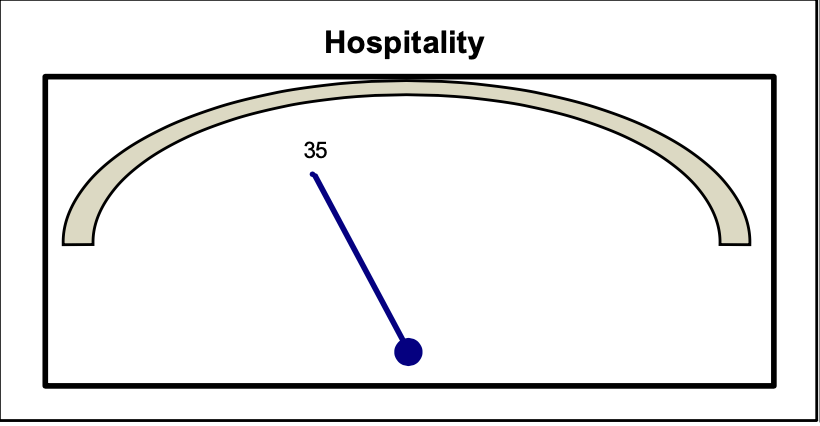
Both the Traditional and Baby Boomers score their church in terms of hospitality in the average range of 41%-47% in our database. Traditionalists score their church the highest on welcoming new guests, being enriched and welcoming to people from many different walks of life, and church giving new meaning to their lives. All of these areas for this generation score at or above the 50% range, average to high-average in the benchmarking. Baby Boomers score all of their hospitality measures as a church in the 38%-55% range.
Traditionalist Index
Baby Boomer Index
Unfortunately, the younger generations are not experiencing the same level of hospitality. These scores are shown below left to right. Gen X scores their overall churches hospitality in the low range, 28% in the benchmarking. Millennials score the hospitality of their congregation in the low average range, 35% in the benchmarking. Gen Z scores, when reflecting on the hospitality scores in their congregation, are the lowest at 19% in the benchmarking.
It is important to break this down a bit further. Looking at this data, Baby Boomers are scoring their church hospitality in the 41% and the Millennials are scoring hospitality just 6% lower, at 35%. This might make us wonder “is that really a difference that has a distinction?” The answer is a resounding yes.
Each generation has a clear culture and value set. While not all individuals within each generation will fit these descriptions, it is important to understand the cultures as a whole if we are truly committed to creating community together.
Traditionalists were a part of significant historic events, these events were very defining for this generation. Most in this generation are retired. They value traditional forms of communication and personal touches from those who seek their contributions of time or money.[4] Traditionalists are loyal to the causes and communities they support. Once they find a community they tend to stay committed for long periods of time, regardless of the ebs and flow of that community over time.
When Baby Boomers were and may still be in the workforce, work was the center of their lives[5]. They are a generation that highly values individualism and self-assertiveness. They give time and money to nonprofits and other community ventures based on a duty-driven model. As stated in a study conducted by Nonprofit Tech for Good, “Baby Boomers support traditional, well-established organizations with a proven track record of impact. Religious institutions, universities, and healthcare charities tend to receive substantial contributions from this generation.” Baby Boomers to not need to feel welcomed or connected to an organization to give time or other resources. It is nice if they do feel that connection, but it is not essential.
In contrast, Gen X began assessing the work-life balance when they entered the workforce. Unlike previous generations, Gen X needs personal connection in order to give of their time, gifts, or money. This generation is self-sufficient and values flexibility and informal spaces to connect. They are known for being pragmatic and will research thoroughly before joining a community or donating.6 Gen X currently leads nationally in annual volunteer hours served but does this work only when they can see the direct impact of those causes in their community.
Millennials have come after Gen X benefiting from the shifting work-life balance. This has resulted in a generation that is highly empathetic, values interpersonal connections, and looks for a way to live out their socio-political values4 in both their work and personal life. Millennials give when they experience a connection that is often peer-to-peer and need to understand how the time and money they are giving is connected personally.[6]
Gen Z is the newest generation and studies have not fully formed how that generation interacts and gives. What we do know is Gen Z is a generation that values truth, exploration, and identity or even lack of identity.[7] They look for work and a community that prioritizes mental health, and open and honest communication while fostering collaboration.[8] When giving time or money they want to see immediate impact so they can be assured they are making a difference.
At Holy Cow! Consulting, we sit with church leaders several times a week across the country. The common struggle that we hear is that “we need young people to engage and help in our congregation’s work.” These comments are often coming from a group where the average age over 65. The Baby Boomer generation engages this way – there is a need so we do the work. From that perspective there is frustration, and to some extent understandable frustration, that the younger folks are not stepping up. But unlike in the past, we cannot ask the younger generations to “just engage” without being mindful of connection because that is not their culture.
I find myself saying time and time again, younger generations will do and make time for what they find meaningful. If Gen X, Millennials, and Gen Z do not feel connected or invested in personal relationships within the congregation, they will not be inspired to give of their time, their talents, or their money. Hospitality, that welcome and connection, is even more important for these generations because without it, they will not find their life in the congregation meaningful. And as all the data and research says, without that meaningful personal connection, your congregation cannot effectively engage younger generations.
We cannot cling to the old ways of doing things and expect new results. This longing for meaningful relationships and this perception of lower care from the church in terms of hospitality is an important indicator of where the church is missing opportunities to touch lives and create community.
Our congregations have questions that must be answered by all generations. These questions include:
How can the older generations be open to shifting their way of thinking and connecting with the younger generations?
How are we welcoming the younger generations into our congregations so they can feel valued and a part of what we do together?
How are we listening to the needs of those younger generations within our congregations and responding?
How are we managing our expectations of what younger people can give and how they can give it?
What can we give each other in community that we cannot get anywhere else?
Scripture promises us that Jesus remains the same, that is our constant. What must change is the way in which we care for each other.
[1] A portion of the Gen Z population was and is under 16 years of age and therefore not typically eligible to take the CAT assessment.
Written by: Emily Swanson, Owner/President of Holy Cow! Consulting
As we shared in our last post, starting in early 2019, Holy Cow! Consulting asked responders to the Congregation Assessment Tool (CAT) which generation they are a part of with a given list of choices. Responders can pick one of the following:
Traditionalist/Silent Generations: Born 1928-1945
Baby Boom Generation: Born 1946-1964
Generation X: Born 1965-1980
Millennial Generation or Generation Y: Born 1981–1996
To read the beginning of this study and the overview please check it out here. This week we will be looking at the worship experience by generation, specifically music.
PART TWO: WORSHIP
Excellent Worship and Music are essential parts of being a healthy congregation. This comes as no surprise. This is a large part of what church does – we come together, giving our deepest affections and highest praise to God through our worship. It truly matters. In the Congregation Assessment Tool (CAT) we ask two questions around worship. The first asks responders if the music at our church is outstanding in quality and appropriate in style to our congregation. The second question asks responders whether the worship service at our church is exceptional in both quality and spiritual content.
Out of the 11,480 responses, the highest level of overall vitality is found in the two older generations, Baby Boomers and Traditionalists. These two generations have an overall higher sense of satisfaction and energy within their congregations.[2] Their worship experience is much higher than the other generations as well. Over 52% of Traditionalists strongly agree that the music at the church is outstanding in quality and appropriate in style and 59.3% clearly agree that that their worship services are exceptional in both quality and spiritual content. Comparatively, over 56% of Baby Boomers strongly agree that the music is outstanding with 59.4% clearly agreeing their worship services are exceptional. To put these numbers in context, a vital congregation that scores high in their music scores has over 65% strongly agreeing that they music quality and appropriate in style for their congregation.
Baby Boomers and Music
In contrast, while 59% of Millennials clearly agree their worship is exceptional, only 44.6% strongly agree that the music is outstanding. This is 10% lower than the what the Baby Boomer generation is experiencing in the worship music. Likewise, only 44.7% of Gen X responders can strongly agree that the music is outstanding with 53% clearly agreeing that worship is exceptional. Gen Z has the lowest rating for their congregational music with just 41.2% strongly agreeing that that the music is outstanding. Over 10% of Gen Z responders disagreed or strongly disagreed that the music is outstanding which is a much higher level than any of the other groups.
GenZ and Music
Millennials and Music
If worship is the time a congregation comes together, either in real life space, online or both, to communally experience God, this type of generational gap in experience at worship begs the question “who is worship for?” The clear answer is it should be for everyone. However, with these differing experiences in our churches, if congregations are not making necessary changes to engage the younger generations in music that is meaningful to them, they are clearly drawing a line of who worship is really for and, according to the data, it is not the younger generations.
It is rare to find a church that doesn’t have story around trying different music and failing. Here failing is often defined as upsetting part of the congregation. There is often a digging in of heels and clear statements around not liking certain aspects of the music. Perhaps, most harshly, there are statements of withholding both attendance and financial giving if changes are made. While this might sound extreme it is more common than we would like to think. I recently worked with a congregation where the music decision was so divisive that the sanctuary itself became a battle of dismantling and then putting back together pews, risers, instruments dependent on what the leadership decided in their contentious weekly meeting. It was painful for everyone and resulted in a consistent loss of attenders and members.
For decades, when churches were larger, the easiest answer was to create multiple services with different types of music. This did not create a learning in collaboration or mutuality but instead a mindset of “there is something for everyone, in different places.” This adaptation in a lot of churches did not create connection or community across the groups within the congregation. As this model for many churches has proven to be unsustainable, they find themselves back at the place where they need to find a better way to work together.
Churches should be charged with making thoughtful and inclusive decisions around incorporating musical styles into their worship that speak to all sets of generations within their congregation. There should not be an assumption that the younger generations want more contemporary music, in fact, some of the churches in this study offer that, but instead of guessing we need to have meaningful conversations around what music would help us deepen our connection to God. The question is not “what would make everyone happy with our worship?” that is asking the impossible. Instead, the question is “how can we find a way to worship together that brings meaning and depth to all of our attenders?” There needs to be accountability for those with longer tenure to be open to not just what they love but a “bless and add” approach that includes what they love and something new.
This is no small task. Trying new things and being open to change is hard and it doesn’t always seem practical. Even little changes can feel hard.
On mornings when I drive my kids to school, I go the same way. I truly think it is the best way and well planned. I have considered the traffic stops and traffic flows. It is fast and efficient. One day my then fourth grader said “can we go by the house with the huge skeleton in the front yard?” There is nothing fast or efficient about going half a mile out of the way to get to school because of a skeleton decoration. It is not well planned and certainly does not take into account traffic flow. It is just not how we have done things. But, as we both stuck our heads out the window and laughed at the yard with the very large skeleton, I realized that maybe the way I drive to school isn’t the best way. Yes, my way saves time and is about what works for me but if we leave five minutes earlier, we can do something different and we can do that new thing together with laughter involved.
This might seem like a silly comparison, but the point is any change takes an adjustment and it often needs to feed our soul. If Jesus was anything, he was a catalyst for change, but it was change that was rooted in healing those who needed healing, reaching those who were isolated and speaking the truth to power. Comfort in routine is human but change is equally important. It allows us practice courage, become open to something new that we might enjoy, helps us to embrace failure, and forces us to grow.
Change for change’s sake is not what we are suggesting. Be wary of change that is suggested without a clear why. But change with the intent to build a more welcoming and meaningful worship experience is change for a very good reason. Remembering always:
And we know that for those who love God all things work together for good, for those who are called according to his purpose.
Romans 8:28
[1] A portion of the Gen Z population was and is under 16 years of age and therefore not typically eligible to take the CAT assessment.
[2] It is important to note that age is not an indicator of energy or a compelling sense of purpose within congregations.
Written by: Emily Swanson, Owner/President of Holy Cow! Consulting
The Study Make-up
Beginning in early 2019, Holy Cow! Consulting asked responders to the Congregation Assessment Tool (CAT) which generation they are a part of with a given list of choices. Responders can pick one of the following:
Traditionalist/Silent Generations: Born 1928-1945
Baby Boom Generation: Born 1946-1964
Generation X: Born 1965-1980
Millennial Generation or Generation Y: Born 1981–1996
Out of the hundreds of mainstream denominational congregations who have taken the CAT since 2019, HC!C looked at 110 congregations who responded to the generation question, to see what can be learned from that data. This data set was comprised of 11,408 individual responses. Within this dataset the percentage of responses by generation are below:
Denominationally, 31% of the congregations were Presbyterian (PCUSA), 22% were Episcopal, 10% were Evangelical Church of America, 17% were United Methodist. The rest of the congregations included congregations with the following denominations: United Church of Christ, American Baptist and Lutheran Church Missouri Synod.[i] These churches are within different regions of the United States, including 34 states with congregations in urban, suburban, smaller communities and more rural settings.
For this study, the responses are for individual that are already a part of a congregation in one way or another. This is not a way to understand those who are “unchurched” but rather a way to better understand those individuals who want to be a part of church and are committed enough to respond to the CAT so their opinions and perspectives can be considered.
This is what we want, right?
In 98% of over 6,000 congregations in our database one of the top three priorities is to grow with families with children and youth. When asked why this particular growth is necessary, many church leaders will state that it is because they are older, tired, financially insecure. There is also the fear that when they are gone, the church will also die. Some church leaders will also cite the Great Commission that is the church’s calling to create disciples. When these groups are asked “what does this younger demographic need from church” the same church leaders are often unable to answer that question. This leads anyone truly listening to conclude that what congregations need from the younger generations is their work, time, money and longevity of membership with unclear ideas of how what they can give those younger generations in return. While anyone could say they would have a relationship with Jesus and be able to worship with us, the question of “what do the younger generation need from their relationship with Christ and from worship” is equally met with lack of clarity and a lot of guessing. To state the obvious, we don’t know what we don’t know.
While society has changed and is often cited for many of the issues regarding religion and church attendance, we also need to admit that perhaps our churches have not changed and that stagnation could be equally, or at the very least partially, responsible for the lack luster response of younger generations when asked about attending church. Often mainstream denominational church has stayed focused on the generations who began attending church as young adults in the 60s, 70s, and 80s while not taking into account what might be meaningful or engaging for the younger generations they are wanting in their congregations. Arguably, this disconnect has become detrimental to both the vitality of our congregations and those we seek to serve.
This leads to two very important question that every congregational leadership needs to ask:
Do we truly want to meet the needs of the younger generations in our congregation, even if that means we might not all like the change that requires?
How will we find out in a clear way what the needs are of the younger generations that we are inviting into our congregation?
This last year, I was with a church in rural Ohio where the average age of attenders was 71 and the church regularly has 45 people in worship. They, like many, wanted to grow with young families. When pressed to talk about how they would take steps for this type of growth the response was they did not want children in worship making noise, they did not want to make any adjustments to what they enjoy in the current worship, and they wanted to make sure any new people gave money and time to ministry. I recited back to the group that they wanted a young family to come with children who were not welcome in worship (because children are the very definition of noise), have no opinion about worship beyond what is already offered, and have extra time and money to give. There were nods around the room but also chuckles because in that moment they knew they were asking the impossible. I am often reminded in these moments that mirrors under particular lights are harsh, but they are still mirrors.
1 Corthinians 13 is often a favorite passage for weddings but as I have worked with congregations over the years I have often thought it is best used within its original intent which was, in part, to heal divisions in the church and give clarity around healthy leadership. The Apostle Paul writes:
Love is patient and kind; love does not envy or boast; it is not arrogant or rude. It does not insist on its own way; it is not irritable or resentful;[ it does not rejoice at wrongdoing, but rejoices with the truth. Love bears all things, believes all things, hopes all things, endures all things. Love never ends.
So, while the two questions listed above for congregations to consider are important, perhaps the most important question is the third one, which asks: as a congregation are we committed to truly love the people we want to reach?
What are We Measuring?
As a consulting company, Holy Cow! Consulting has talked for years in one way or another about the overreliance on count data in our churches and in our mainstream denominational systems. Churches typically rely on the number of members, or those in attendance, and financial as a measure of vitality. This is not a clear indicator of a healthy system. Over and over, the data indicates that churches with large attendance numbers and robust giving can be riddled with internal issues such as systematic conflict, a breakdown of trust in leadership and low hospitality. There are also many smaller congregations with high vitality, strength in ministry and high levels of care for each other. Count data is not a way to measure anything in the church except to convey how many people and how much money. What we need to understand instead is what people are experiencing or what we call “witness data.”
The true measure of vitality for a congregation is determined by the level of a congregation’s satisfaction and energy. This is a common way to measure organizational health through-out many industries and the church is no exception. Satisfaction in this context means a feeling of peaceful contentment with meaningful belonging and an absence of discord. Energy is a compelling sense of purpose or passion with intention. Both satisfaction and energy are needed to have a vital congregation. Satisfaction on its own leads to stagnation and a lack desire to make necessary change. Energy on its own leads to changes made for change sake and mission creep. Satisfaction and energy together at a vital level lead to both clear missional alignment and wise adaptive change.
Out of 2,800 churches that have taken the CAT in the last 6 years, 10% of mainstream denomination churches are growing in attendance. These churches have the following:
Exceptional Worship
Skilled Conflict Management
High Trust in Lay Leadership
High Hospitality
Systematic Flexibility
Quality Educational Programming
To be clear, this is list has not changed in the last 15 years. In fact, internally at Holy Cow! Consulting, we have this list memorized because there is rare notable deviation from this list and high congregational vitality. They go hand-in-hand and though, from one church to another, this list of six might look different in terms of style, format and execution the fact remains they need to be done exceptionally well within that congregation.
There are two things that receive a lot of focus that do not create vital churches. They are spiritual vitality and theological prospective.
Many mainstream denominations in the last 15 years have created assessments focusing on the individual spiritual vitality of church members. The assumption of assessment takers in church then becomes if we are spiritually vital individually this is then reflected in the health of our church. While this day to day relationship with Christ is important, it is a misnomer to assume that a group of people with a deep spiritual walk come together and create a healthy system.
Looking at this another way we can all love coffee (apologies to the tea drinkers) and enjoy our local coffee shop. But putting together 10 people who love coffee and a daily walk to their favorite coffee place doesn’t then make a group of people who can successfully design, open and run a café. We might think we can, but we can’t. Church is more than an individual love of God or the call of Christ in our lives. It is a coming together of people who can work together to create something beautiful and meaningful for the group– this requires and leans on many strengths beyond just our daily spiritual walk.
Likewise, whether a church is theologically progressive or conservative does not indicate whether a church is vital or healthy. We have become quite comfortable in dualist thinking. This thinking assumes there are only two contrasting, mutually exclusive choices or realities. It looks at the either/or, bad/good, negative/positive. As Richard Rohr, founder of the Center for Action and Contemplation, writes:
This is the ego’s preferred way of seeing reality. It is the ordinary “hardware” of almost all Western people, even those who think of themselves as Christians. The church has neglected its central work of teaching prayer and contemplation, allowing the language of institutional religion itself to remain dualistic and largely argumentative. We ended up confusing information with enlightenment, mind with soul, and thinking with experiencing—yet these are very different paths.
Recently, I was working with a Presbytery Strategic Planning Team and one of the team members was a business consultant. The group was looking at two paths to address an issue and the consultant in the group said “why is this not a ‘yes and’ solution?” This changed the trajectory of the plan and opened everyone up to bigger possibilities not limited by the either/or. It took everyone out of dualistic thinking and leaned into imagination and creativity.
While we can blame social media or other cultural influences, the reality is dualistic thinking is easy. It allows us to ignore nuance and removes doubts. But easy is not the same as healthy. When we ask churches about their view on scripture, education, historic faith commitment, and conversion to Christ, none of these responses indicate the vitality of the congregation. Whether the congregation takes a more literal view of scripture or claims that to create a better society the first step must be conversion to Christ, the congregation can be an extremely vital system or be mired in unhealth. Neither side of the theological spectrum indicates what the experience within the system is. Instead, the conclusion of the data is that there is no “right way” to think theologically but instead a healthy way to be church together.
What have We Found
Over the next month we will be sharing our findings of generational divides in three areas: worship, hospitality and connection, and outreach/ministry. As we have reviewed the data these three areas need attention in order to ensure that younger generations feel welcomed and accepted into the life of the congregation. We look forward to sharing this information with you.
[1] A portion of the Gen Z population was and is under 16 years of age and therefore not typically eligible to take the CAT assessment.
[i] Presbytery of Charleston Atlantic, Presbytery of Chicago, Presbytery of Cincinnati, Presbytery of Detroit, Presbytery of Eastminster , Presbytery of Giddings-Loving, Presbytery of Hudson River, Presbytery of Missouri River Valley, Presbytery of National Capital, Presbytery of New Hope , Presbytery of Peace River , Presbytery of Pittsburgh, Presbytery of Northern Kansas, Presbytery of Baltimore, Presbytery of Tropical Florida, Presbytery for Southern New Jersey, Presbytery of Seattle
Episcopal Diocese of Arkansas, Episcopal Diocese of Atlanta, Episcopal Diocese of Colorado, Episcopal Diocese of Southeast Florida, Episcopal Diocese of Georgia, Episcopal Diocese of Massachusetts, Episcopal Diocese of Michigan, Episcopal Diocese of Northern California, Episcopal Diocese of North Dakota , Episcopal Diocese of Oklahoma, Episcopal Diocese of Southern Virginia, Episcopal Diocese of Western North Carolina
La Crosse Synod ELCA, New England Synod, ELCA, New Jersey Synod, ELCA, Northwest Wisconsin Synod, ELCA, Rocky Mountain Synod, ELCA, South Carolina Synod, ELCA, St. Paul Area Synod, ELCA
Illinois Conference of United Methodist Church, Iowa Conference of United Methodist Church, Michigan Conference of United Methodist Church, Northern , New York Conference of United Methodist Church, Ohio Conference of United Methodist Church
I am not one to typically write blogs. We are inundated with ideas and concepts and information. Certainly there are many church consultants who blog and tweet on various formats better than I could or honestly would want to. We are a boots-on-the- ground kind of organization so I often leave the high level conjecture to others. However, I think it is important to share what we are experiencing at Holy Cow! Consulting and how we are seeing this in churches and regional associations across the country that we work with each year.
Before COVID, we heard a lot about ‘scarcity.’ It was truly on every church’s mind. We, as church, have learned over many, many decades that we must measure our successes in count data. Simply put- how many people, how much money is the church measure of vitality. This mindset has amplified in this current season while we live into the post-pandemic era. I would describe it as a fever pitch. If you Google “mainstream Christianity,” you will see those words coupled with “decline,” “dying” and “unchurched.” I am sure this doesn’t surprise you.
If you talk with congregations you will hear about how people are home in pajamas and with coffee comfortably streaming their worship experience. The concept of “they are never coming back to church” has truly rooted itself into church culture and it has caused high levels of anxiety. Not to mention how judgmental we have become of pajamas and coffee during worship.
Our love of count data as a measure of success could be because it is easy to measure. Numbers are easy and clear (we like them too because we work in data). Or it could be because we truly believe if we do not have the most people or the most money then indeed we are not living out the Great Commission. Or maybe it is our societal culture telling us that bigger is always better. I cannot fully comprehend it because we find that even churches with the largest attendance and largest budgets still tell us they do not have enough people or money. This always leaves me with the question: How much or what is enough? At what number can we stop focusing on scarcity?
The problem with count data is its limit in scope, it stifles creativity and risk-taking, and, ultimately, when it becomes how we singularly determine our health as churches, it fails us miserably. Count data does not tell you how deeply you are experiencing God in your day to day life, or the ministry that your church does for those in need in your community, or how the congregation has experienced transformation. It does not take into account the people who give their time to lead your congregation or visit members in their lowest moments, when someone sitting with us is exactly what is needed. It does not tell us about the joy of meaningful relationships or the moving music that connects members to God in one space together. Count data just tells us simply that you have people and money. It just does not tell us how healthy you are as a church or the great work you can do together. And where is God in it anyway?
The scarcity narrative is dangerous for the church because it has led us to survival mode. Having meeting after meeting about what we don’t have, we become continually more anxious as a congregational system. We cannot imagine a way out. We seek quick fixes that are not imaginative, creative, or truly meaningful. We want younger people so we don’t die as a church. We need money to keep our buildings. We can’t agree on a path forward and often find our congregation in debilitating conflict. We set aside connecting with each other both spiritually and relationally to make way for faster meetings and avoid important things that truly need our attention. Because when we only look at count data it will never be enough.
Our churches must move to an abundance narrative. What is it that we do have? Do we appreciate it? How are we fulfilling God’s mission? What difference are we here to make and for whom? If we are only 30 people doing good work together in Christ’s love; then we are enough! What are the things we can do exceptionally well with what we already have? What can we let go of to do even more good in the world? Because we are not called to tightly hold onto what we have. We are called to be in the world sharing what we have with our time, gifts and treasures. We have to measure our success by the legacy our churches carry forward in love, joy and abundance.
We are desperately being called to try new things, to imagine different ways of looking at what it means to be church, and how we use the many gifts and resources we have.
This does not mean that we go into an abundance narrative without a clear understanding of our limitations. This is not meant to ignore issues that congregations face that are real and daunting. But truly, church leaders in every meeting I have ever been in are always quickly and seamlessly able to tell me what those daunting issues are. It is when I ask where do you see God working in this congregation that people truly have to stop and think. The silence can be deafening. Obviously, this is a narrative we are not in the habit of sharing.
It is time to create new habits, believing that we are the beloved who can breath new life into our gifts and our ministries. Let the count data be what it truly is – just numbers.
I had a Presbytery staff member say to me recently “it just seems like we are always talking about viability and not vitality – they are very different. We need to change the conversation.” This comment and my experience this weekend reminded me yet again that indeed the two are very different. Both also reminded me of why we do what we do at Holy Cow! Consulting.
On Saturday, I worked with a congregation in St. Louis that has an average weekend attendance of 68 people. If we talked about viability or just looked at count data it would give us pause. But that is not our job at Holy Cow! Consulting. We start by looking at vitality.
Out of the 1,855 other congregations this congregation was benchmarked against, it was in the 99 percentile for both energy and satisfaction. Meaning, that only 1% of the churches in our data base had a higher level of morale and vitality. They were also in the 99 percentile for flexibility and in the very high range for conflict management abilities, trust in leadership, readiness for ministry and other performance indices. Where they need to be doing well, they are doing extraordinarily well.
I have written before about the small but mighty congregations. Count data will not help us find our vital congregations. We cannot assume that a church that has 1000 or 500 people in average weekly attendance has the necessary vitality to sustain a healthy congregation even though, on their face, they suggest viability. And, we also cannot assume that the smaller congregations that are hitting the ground running with internal health and external focus do not offer best practices and ideas that can help us better understand what makes a vital congregation. We need to learn from these small but mighty congregations because, equal to vital congregations of larger size, they are the ones to watch over the next five years.
So, as congregations and regional associations, let’s move the conversation past the question of viability. Let’s set aside the count data, we know what it says. Instead, let’s begin our conversations about congregations with vitality and see what God has in store.
Emily Swanson, President of HC!C
*With the congregation’s permission I am sharing that the congregation I wrote about above is First Presbyterian Church of St. Louis, MO. If you are a smaller congregation or assist other small congregations in their work, I would suggest reaching out to these folks for some ideas as you move forward. Their website is http://www.firstpresbyterianstl.com
To date, our team at Holy Cow! Consulting has worked with close to 3,000 congregations. We have worked with congregations in every U.S. state with the exception of Hawaii (unfortunately for us). We have been stuck in snow storms in Minnesota, lost in the woods in Wisconsin, seen Mount Rainer in the rearview mirror, found out how cool Omaha is, hung out with a seal in San Diego, forgotten to order unsweetened iced tea in South Carolina, and been gently heckled by congregations in Michigan because we have a lot of OSU allegiance in our office. We have covered a lot of ground over the years and have met a lot of amazing people.
If we are running a Congregation Assessment Tool (CAT) within our current database, the data is benchmarked against around 1,800 congregations – this number grows every day. Approximately 88% of those congregations within our current benchmarking have run their CAT in the last five years.
Just as overview, when we look at the database this is a general overview of its makeup:
411 congregations are Evangelical Church in America (ELCA)
412 congregations are Episcopal
375 congregations are Presbyterian
68 congregations are Methodist
80 congregations are United Church of Christ
25 congregations are Nondenominational
24 congregations are Lutheran Church Missouri Synod
The remaining numbers include congregations that are Baptist, African Methodist Episcopal, ECO, LCMC, and various other mainstream denominations
So why do we benchmark? Benchmarking allows us to take the data from each congregation and remove the element of guesswork. For example, when we look at hospitality within a congregation, one of the questions we ask people is whether “a friendly atmosphere prevails among the members of our church.” If 61% of the congregation clearly agree with that statement, just looking at the raw data, that appears to be pretty good level of hospitality. That is more than half of the people within the congregation saying that there is a friendly atmosphere. But when we compare the data within the benchmarking, we find that this only puts the responses to that question in the 12th percentile. So, 87% of the other congregations in the database had more people clearly agree with that statement. This significantly changes what we understand from the data. We are able to move from trying to guess “is this how it is supposed to feel” and we can see what is typical and what is exceptional about each congregation.
When we talk about benchmarking, one of the most frequent questions we get asked is ”why don’t you benchmark us against other churches in our denomination.” The denomination question is usually followed by a general statement about who they are as Lutherans, Presbyterians, Episcopalians, etc. Notably, here and there, the data can show some national denominational tendencies which we have noted in our denominational books. But generally, those statements about who each denomination claims to be has yet to play out meaningfully congregation to congregation in the data.
For example, if you look at the maps on the left, they include all of the ELCA congregations in our database. You can see that they range anywhere from very low energy and satisfaction to very high energy and satisfaction. Likewise, these ELCA congregations are conservative and progressive, flexible and settled.
When we receive an order for the CAT from an ELCA church we cannot predict where that congregation will land in any one area. Instead, the data tells us that each ELCA church could land anywhere in the benchmarking – and this is important.
But there is an even more important reason why we benchmark the way we do. Both the Pew Research Center and the Cooperative Congregational Election Study (CCES) looked at mainstream denominations over a four-year period. The Pew’s study ended in 2016 and CCES ended their four-year study in 2015. What they both found is that within that four-year period 16% of members in mainstream denominations changed denominational affiliations. Methodists become Episcopalians, Presbyterians became Methodists, Lutherans in the ELCA moved to the LCMS.
What does this mean? Let’s break this down by year and attendance. 16% over four years, is 4% per year. This means that if a congregation has a weekly attendance of 150 people, there is the potential that the congregation will lose 6 people per year. By the end of four years, it is estimated that 24 people in that congregation will move to another denomination.
This type of movement indicates that benchmarking churches within their own denomination is not how the average member is looking at their experience within their congregation. The average Presbyterian member is not looking at their experience and asking, “is this how I have felt in other Presbyterian churches?” they are instead asking “is this how I have felt in other churches” but also “is there a better place I fit regardless of denomination?” As we posited in “Fly in the Ointment” several years ago, people no longer just buy Ford cars in allegiance to the Ford company. The same is true within our denominational life. People will find the church that fits them and what they need in their life, regardless of the denominational name on the sign out in the front yard.
It is our mission at Holy Cow! Consulting to help regional associations and congregations, through an evidence-based discernment process, become vital, healthy organizations that better serve Christ and our communities. We benchmark the way we do because the data shows that putting congregations in a greater context is essential to truly assess where they currently are in order to help move them to where they are called to be. This is not just our mission, it is also our ministry.
As the team at Holy Cow! Consulting works with congregations all over the country, we find ourselves experiencing two things quite frequently.
The first is the limitation of count data and the same old responses to that data. You don’t have to do a lot of research to find that a large number of mainstream denominations are experiencing decline in worship attendance, as well as a decline in membership numbers. Often the response from regional associations to this decline is that congregations can mitigate these losses by (1) sharing the good news of Jesus Christ and (2) connecting with the growing number of the spiritual but not-religious unchurched people in their communities.
Here we see the limitations of count data. At a national level, denominations know virtually nothing about the kinds of experiences members and visitors are having in their churches. They have no choice but to continue citing the same statistics with the same proposed solutions.
But in fact, churches do not benefit from a pep talk urging them to reach out. Reaching new members and incorporating them into the life of the church is already the first or second priority of 99% of the denominational churches in the USA. The real problem that needs to be addressed can only be discovered through witness data, the power of letting members and visitors speak.
When we listen, we discover the real issues: in the typical church, only half of the members are clearly satisfied and more than a third (37%) feel members are simply “going through the motions.” Until this changes, it will be impossible to make the case that the church is a better option for their lives than the local library, which performs many of the same functions of the church and with a 90% satisfaction level. There are exceptional churches that rise about these generalizations which we call transformational churches. However, our focus on count data means we are neither identifying them nor learning from them fast enough. This also indicates that our congregations are not adapting.
The second experience is a call from an interim pastor who has stepped into a church where the previous pastor left in a state of frustration. In this all too frequent situation, when we run the Congregation Assessment Tool (CAT) and look at the Vital Signs report of the results, it shows a church in the hospice quadrant. This means that unless the church makes changes in the system to achieve a higher level of missional flexibility, the next pastor will also fail, and the next, and the next. This is not the case of finding the leader that fits in the congregational culture but rather a situation where the congregation must decide it is time to change. Without this congregational self-awareness, we are sentencing leaders to failure.
These hospice congregations have made reaching new people their highest priority (as urged by their denomination), but they are a congregation where only 30% of the members feel positive about the church and over 50% of members feel the congregation is just going through the motions. This is not the setting where new people will feel the energy and vibrance of what Christ can bring to their lives within the body of a congregation. Outreach by this church is not only futile; it is likely poisonous.
The way to move past this same old plan that is failing our congregations is organizational intelligence. The enlightenment from Organizational Intelligence (OI) offers meaningful hope for breaking out of the tired clichés and sermonic urgings. OI helps identify practical strategies that hold real promise. It presses congregations to look deeper than count data- helping them take a meaningful look at where they are today, not where they wish they were, but where they truly are in terms of organizational health. And folded into next steps, OI can help move congregations to where they are called to be.
We are here to help when your congregation or regional association is ready to begin this journey.